Karlovy Vary
(the royal city since 1370)
49,100 inhabitants
Karlovy Vary Region, Karlovy Vary District
Historical milestones
After 1340: A royal hunting castle was built on a rocky promontory above the Teplá River near the famous Hot Spring.
1370: Karlovy Vary (Carlsbad) was granted the status of a royal town by Emperor Charles IV of Luxembourg.
1434: The town was pledged to the Šlik family, who began to systematically use the spa resources to treat illnesses.
1480: The town was first documented as the first and, at that time, only Bohemian spa with mineral springs.
1547: The Šlik family lost Karlovy Vary for their participation in the first anti-Habsburg uprising. The town thus returned to Emperor Ferdinand I of Habsburg.
1604: Virtually the entire town burned down in a great fire.
1707: Emperor Joseph I Habsburg restored Karlovy Vary’s status as a royal free town.
1711: The first public baths, called Mlýnské (Mill), are built, and the famous Karlovy Vary spa wafers begin to be baked in the city.
1807: The renowned herbal liqueur Becherovka saw the light of day.
1835: The Karlovy Vary Symphony Orchestra, one of the oldest in Europe, was founded.
1857: The Moser glassworks, still in operation today, is founded to produce luxury glassware.
1870: The city was connected to the railway network of the Empire.
1890: Karlovy Vary was flooded by the Teplá River, prompting the construction of a dam near Březová.
1894: The continental premiere of Dvořák’s New World Symphony took place at the Poštovní dvůr.
1912: Two cable cars were built in the town, one to the Přátelství (Friendship) hill and the other through a tunnel to the Imperial Hotel.
1914-1918: The spa served as a military hospital for veterans of the First World War.
1938: Konrad Henlein presented his eight Carlsbad demands of the Sudeten Germans in the city.
1940-1945: The town retained its status as a military hospital during the Second World War.
1945: Virtually the entire German population of the city is expelled.
1958: The first international film festival was held in the city.
1967-1975: A new Hot Spring Colonnade and a pavilion for the Hot Spring were built.
1992: The town centre becomes an urban conservation area.
2000: Karlovy Vary became the regional capital of the region of the same name.
Interesting facts about the city
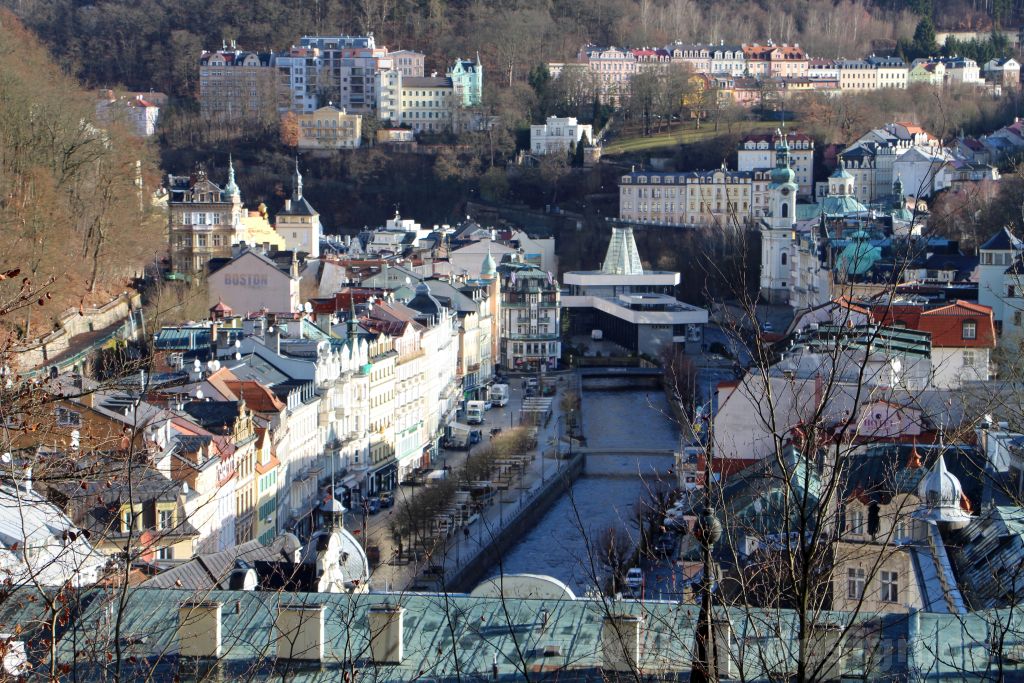
Today’s Karlovy Vary has a completely unique location in a deep valley at the confluence of the Teplá and Ohře rivers. It is surrounded on practically all sides by the relatively steep peaks of the Slavkov Forest and Charles´ Wood. The forest is criss-crossed by a network of hiking trails and viewing platforms, as well as several lookout towers, the most famous of which is Diana with its stone viewing tower from 1914 and butterfly zoo. It is therefore an ideal starting point for hikers. They can view the animals in the Linhart game reserve from above, such as wild boars or fallow deer, or sit on a giant wooden chair at a giant table near the Diana forest lodge.
The city is named after the Bohemian king and emperor Charles IV of Luxembourg, who is said to have discovered the local hot spring while hunting deer, after a hunted deer jumped from the lookout point called Jelení skok (Deer Jump). The name „Vary“ refers to hot springs.
Karlovy Vary is the most famous and largest Czech spa, the first of its kind to be established in Bohemia. The hottest mineral spring is Vřídlo (Hot Spring), which shoots up to a height of 12 metres and has a temperature of almost 73˚C! Warmer mineral springs are located in the floodplain of the Teplá (Warm) River, whose water is heated by them. The temperature of the water also gave this river its name. Colder mineral springs are located at its lower reaches. Each of the 16 springs has a different composition and is collected in interesting gazebos. Mainly digestive tract disorders are treated here. However, you can also bathe in the hot spring water in one of the numerous spa houses, as this spring is distributed throughout the town via pipes.
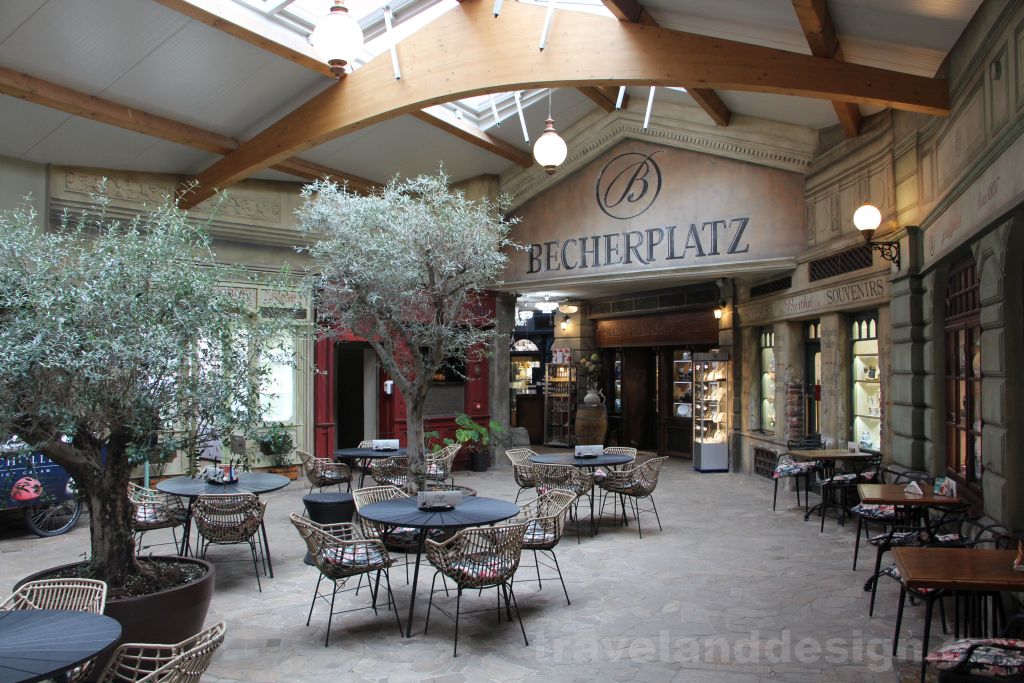
The town is a traditional home to porcelain production in several historic factories, of which only Loučky and Dvory remain in operation today. However, luxury glass decorated with gold or platinum is also produced here in the Moser glassworks, as is the iconic Becherovka herbal liqueur. Its production and various product variations are available at the Becherovka Museum on the main pedestrian zone in the city centre.
Downtown, you can taste the famous hot spring coffee, a typical local product brewed from the waters of the Hot Spring and often heavily flavoured with Becherovka. Beer is also still brewed from the hot spring water, and it is also part of the recipe for traditional Karlovy Vary wafers. The famous local hotelier Johann Georg Pupp used the Hot Spring water to prepare his famous hot spring breakfast soup for the Counts of Chotek.
Since 1899, there has been an Art Nouveau racecourse in the Dvory district, which is still in operation today. The local sports and social activities are complemented by three golf courses, mainly the nine-hole course at Olšová Vrata. The city has been home to golf since 1904, as the first location for this sport in the Czech Republic. The town’s infrastructure is also enriched by its own international airport.
A number of cult Czech films and series have been shot in the town, notably the film Vrchní, prchni! (Waiter, Scarper!), Tři vejce do skla (Three Eggs in a Glass), the Bond film Casino Royale, and two episodes of the detective series Třicet případů majora Zemana (Thirty Cases of Major Zeman).
As part of the traditional Karlovy Vary International Film Festival, the city and spa have been visited by a number of world-famous actors, including Robert de Niro, Robert Redford, Gérard Depardieu, Gina Lollobrigida, Johnny Depp, Richard Gere, Jean Reno, Mel Gibson, John Travolta, Morgan Freeman and Michael Douglas.
The biggest tourist magnets
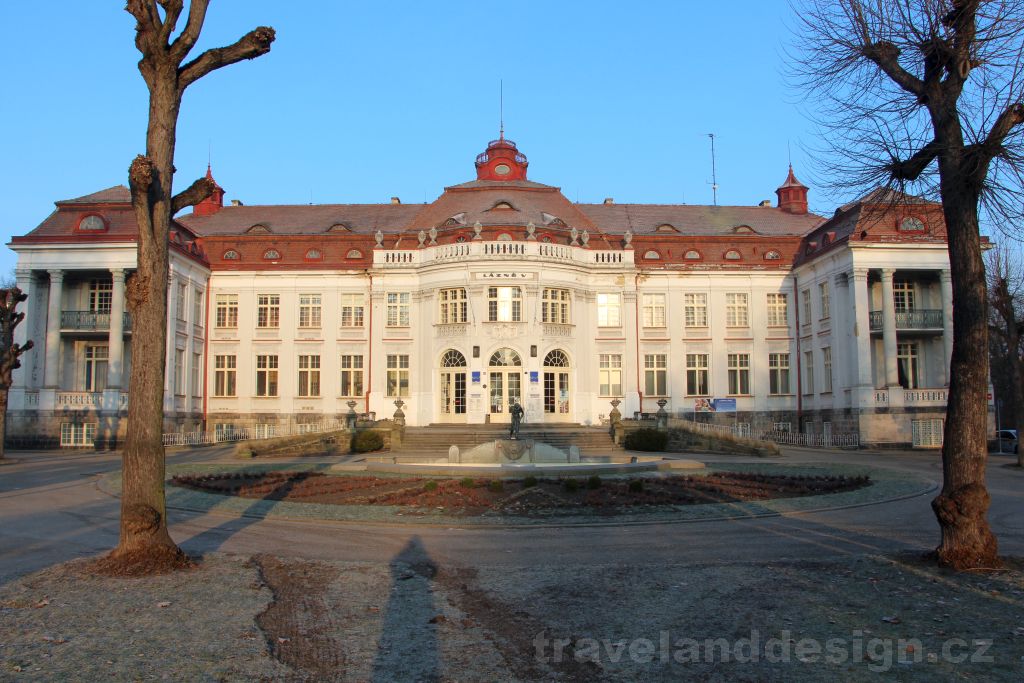
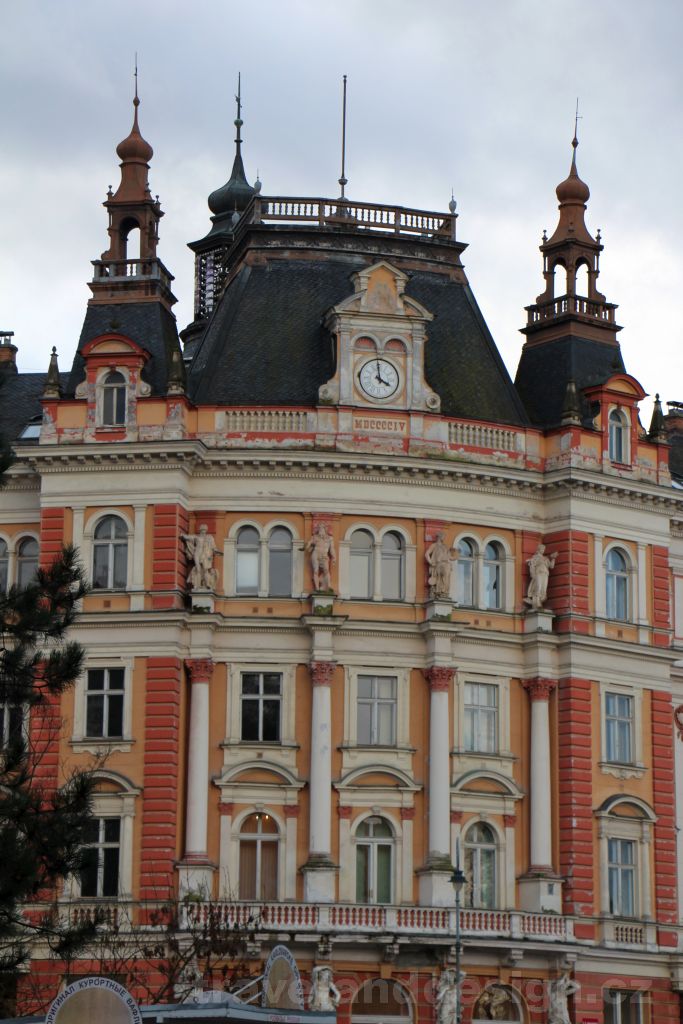
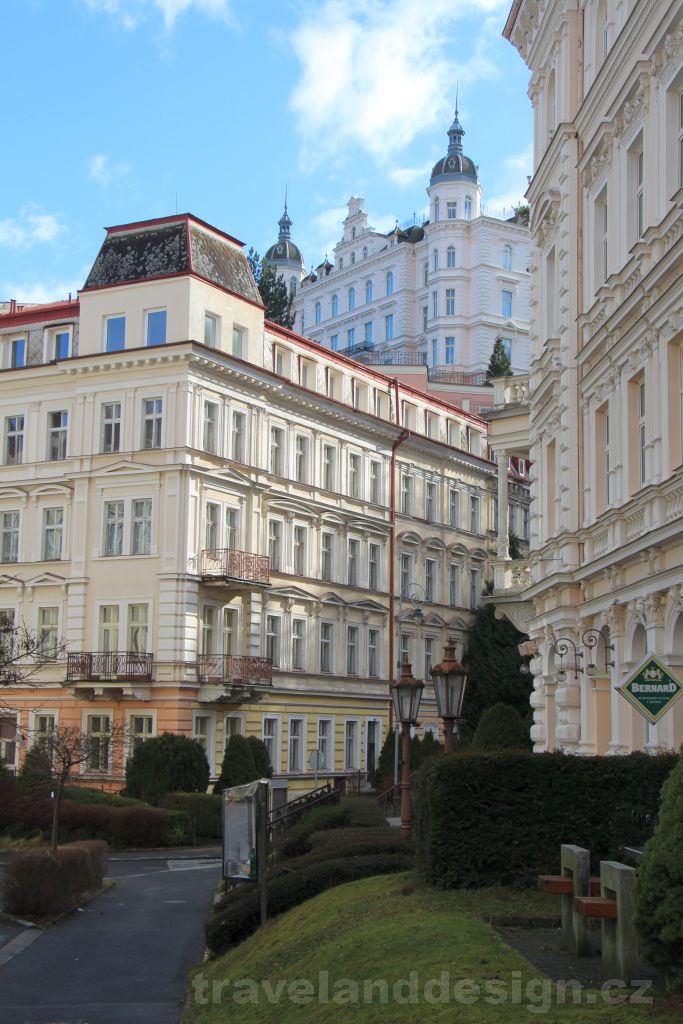
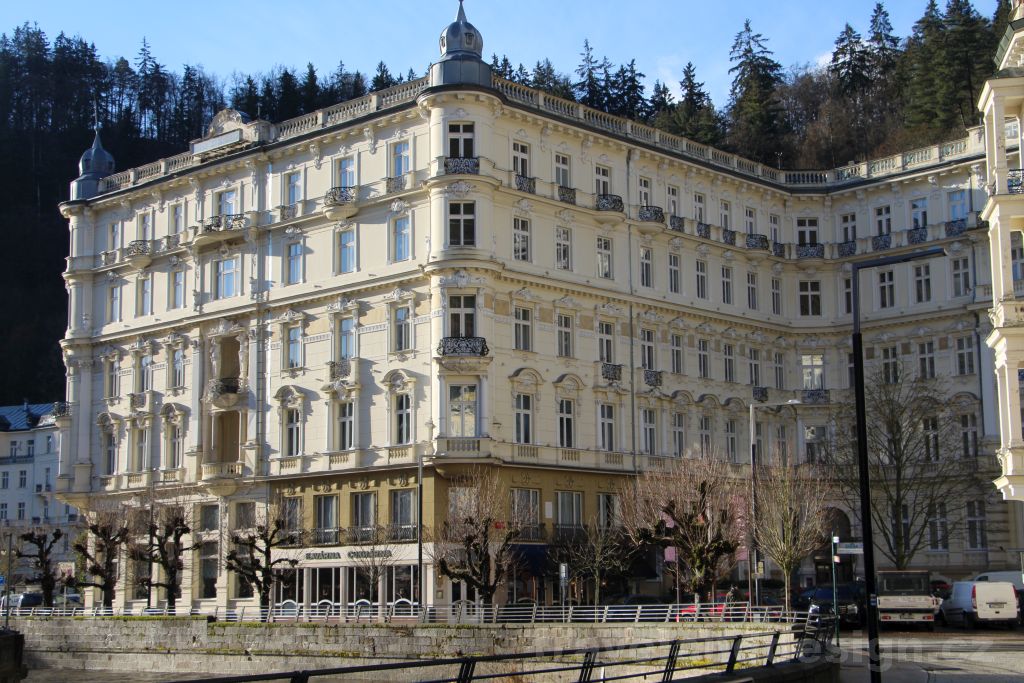
Karlovy Vary benefits from the collective heritage protection of West Bohemian spas provided by UNESCO, and so there are many interesting monuments related mainly to traditional spa culture. The architecturally uniform style of predominantly historicist architecture lines the opposite river banks of Stará louka and Nová Louka. It ends with the massive Grandhotel Pupp, which was originally divided into the Bohemian Hall from 1728 and the older Saxon Hall from 1701. To this day, there is a famous pastry shop here, where the Pupp cake, heavily soaked in Becherovka, is baked. Next to the grand hotel stands the newly renovated Imperial Spa, now open to the public, including the preserved Imperial Bathroom, where Gerard Depardieu and the wife of Soviet leader Leonid Brezhnev once bathed. This historic building was constructed very quickly – in just 2.5 years – thanks to the use of the latest technology during its construction. The Zander Hall houses the oldest fitness centre in the country. This building is the work of the famous Austro-Hungarian Viennese studio Helmer and Fellner.
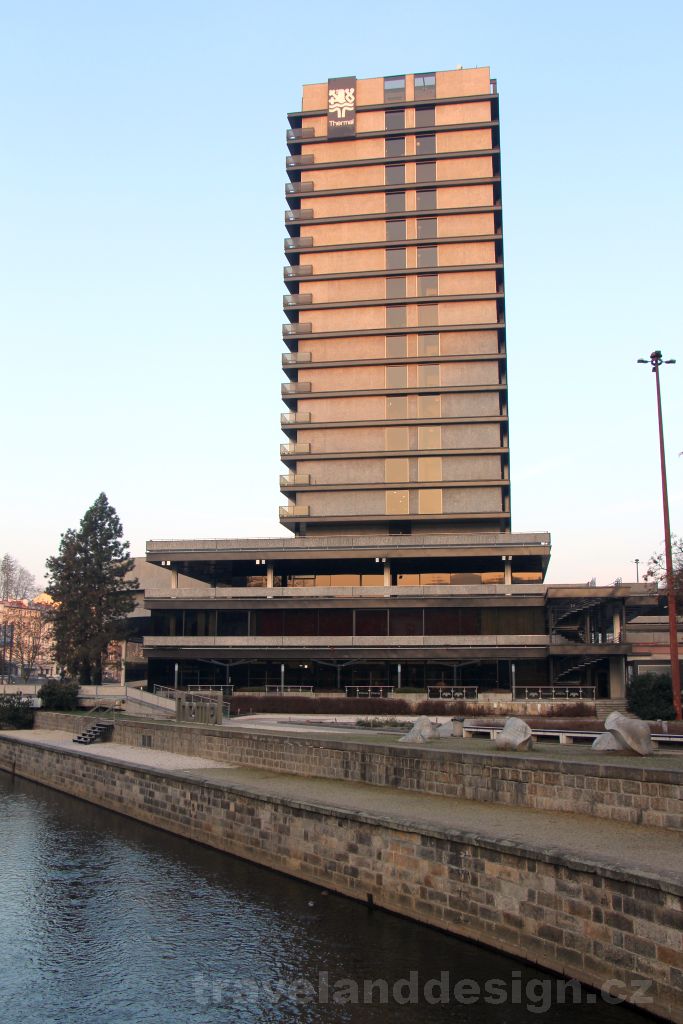
Another interesting local landmark is the Imperial Hotel, built between 1910 and 1912, which dominates the town. It can be reached by a restored funicular railway with a beautiful Art Nouveau upper station. The Richmond Sanatorium is located on the upper reaches of the Teplá River, but it is surrounded by beautiful spa gardens with terraces and the Štěpánka and Dorotka mineral springs, as well as the, which features a relatively recently established Japanese garden. It was founded by authentic Japanese garden architects. The most modern spa building is the brutalist Thermal Hotel from the 1970s. Its interiors are also worth seeing, and the connection between the hotel and the spa wing is unique, where the famous outdoor thermal pool with a breathtaking view of the entire city centre is accessible.
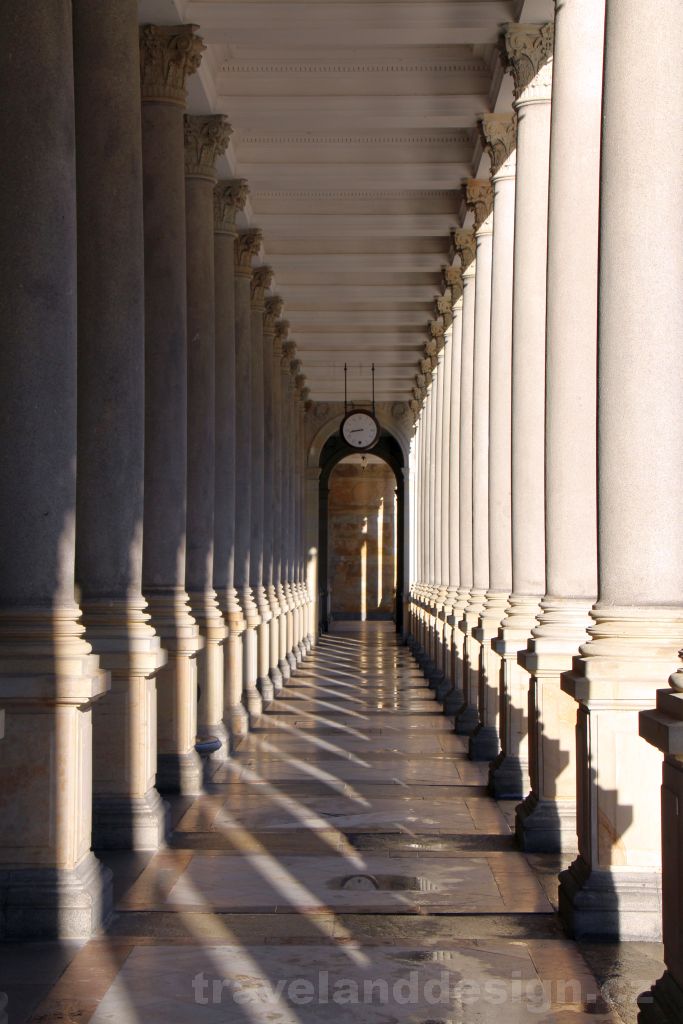
The most beautiful colonnade is a huge open columned gallery built between 1871 and 1881 by the famous architect Josef Zítek on the left bank of the Teplá River. It is called the Mill Colonnade and hides three mineral springs. The younger ones are the charmingly carved Market Colonnade from 1883 and the cast-iron Garden Colonnade with two cooler mineral springs – the Garden Spring and the Snake Spring.
Also worth seeing are the incredibly ornate villas, located mainly in the English-named Westend district. However, the most English-looking buildings here are the terraced houses from the late 19th century on Sadová Street.
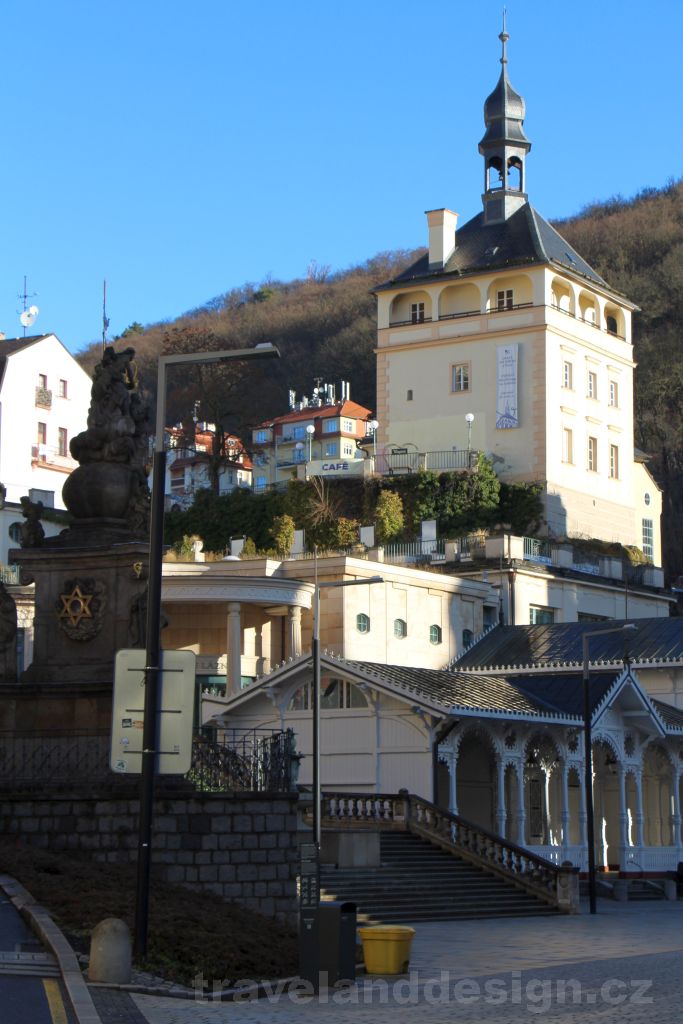
The oldest monument in the city centre is the Castle Tower, the only remnant of the former hunting castle of the Emperor Charles IV. It was renovated in 1608 and today serves as a lookout tower. It is also accessible by lift from the Market Colonnade.
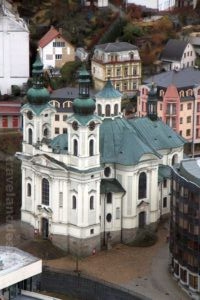
Among the religious monuments, the most interesting is the outstanding Baroque work by Kilian Ignaz Diezenhofer from 1732-1736, the Church of St. Mary Magdalene, which dominates the city centre. The oldest, still romanesque Church of St. Linhart from 1246 stands in ruins deep in the Karlovy Vary forests. Its younger counterpart, the cemetery church of St. Andrew, dates back to the 16th century. Thanks to the international spa clientele, however, two religious rarities were built in the city – the Orthodox Church of St. Peter and Paul from 1893-1897, which has five domes covered with gold leaf, and the former Anglican Church of St. Luke from 1877 with its charmingly gloomy cemetery. Today, its interior of the latter houses a wax museum.
The city’s cultural centre is also the neo-baroque Municipal Theatre, built between 1884 and 1886, and the classicist-style Post Office Court from 1791, which still serves as a venue for social events and as a restaurant.
Famous natives of Karlovy Vary
David Becher, physician (*1725)
Johann Georg Pupp, hotelier and confectioner (*1734)
Heinrich von Mattoni, entrepreneur and founder of the Kyselka spa (*1830)
Karl Hermann Frank, Nazi politician (*1898)
Jan Pohan, actor and voice actor (*1930)
Ladislav Gerendáš, actor and musician (*1946)
Karel Nešpor, psychiatrist (*1952)
Vašo Patejdl, songwriter and musician (*1954)
Karel Dobrý, actor (born 1969)
Aleš Háma, actor and presenter (born 1973)
Lenka Dusilová, singer (born 1975)
Famous people who lived in the city
Peter the Great, Russian Tsar
William I, King of Prussia
Franz Joseph I, Emperor
Johann Wolfgang von Goethe, German poet
Friedrich Schiller, German poet and playwright
Frederic Chopin, Polish composer
Otto von Bismarck, German Chancellor
Ludwig van Beethoven, German composer
Johannes Brahms, German composer
Antonín Dvořák, composer
Emma Destinnová, opera singer
Richard Strauss, German composer
Adam Mickiewicz, Polish writer
Niccolo Paganini, Italian violinist and composer
Leoš Janáček, composer
Franz Kafka, writer
Jiří Bartoška, actor and festival president